

Enterprise deals often involve 8 to 20+ stakeholders, which means relying on a single champion is how deals fall apart late, get blocked, or turn into forecast disasters.
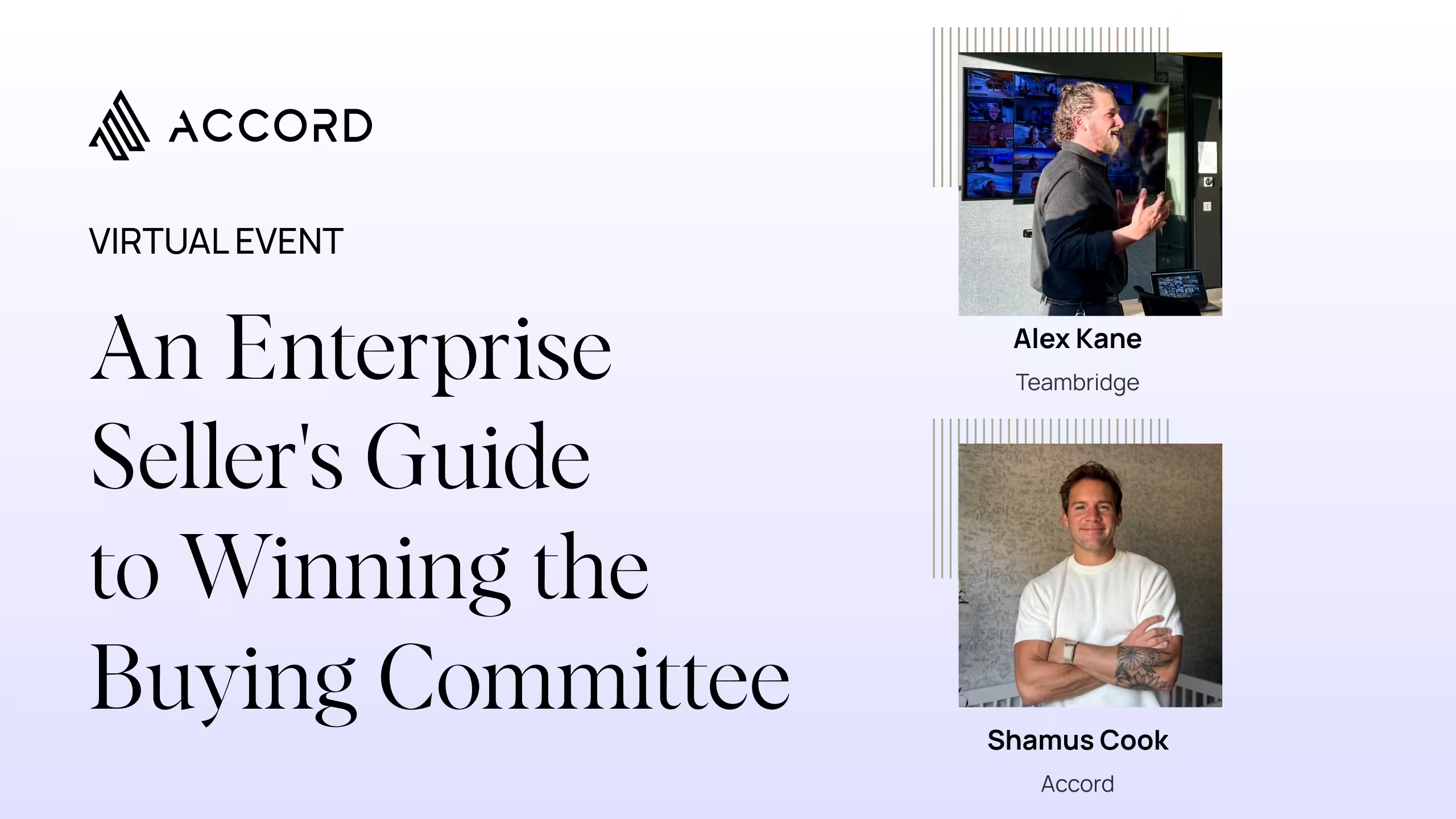
To unpack how top enterprise sellers avoid that outcome, we sat down with Alex Kane, the Director of Strategic Account Sales at Teambridge, and Shamus Cook, the Head of Enterprise Sales at Accord, for a discussion on one of the most misunderstood — and most deal-defining — skills in complex sales: multithreading with intent.
Alex and Shamus walked through the exact strategies they use to eliminate guesswork, improve forecast accuracy, and consistently win over buying committees.
In this recap, we break down:
Let’s dive in.
The first step in mapping a buying committee is to de-risk the deal. Before you think about stakeholder maps, personas, or outreach paths, your job is to remove uncertainty around:
“If more people have given a thumbs up before the committee sits down to vote, and you know whose thumbs are going up and whose are going down, you’re in a good position,” explains Alex. “If you don’t put in this effort, you’re leaving it all to chance.”
When you understand the full committee, you're not “hoping” to win. You know where you stand, who’s aligned, and how accurate your forecast really is.
Strategies to map the buying committee:
Once you’ve mapped the buying committee, your next step is to multithread with intention. You can do this by asking questions like:
But, these questions alone aren’t enough. Buyers don’t always know who needs to be involved, which means your responsibility as the seller is to guide them. Show up with expertise and frame the conversation clearly. For example, you could say: “Here are the typical stakeholders we see at the table by the end of a project like this. Let’s talk through who these people are on your side and build a plan to bring them in.”
One reason sellers hesitate to ask pointed questions is the fear of stepping on their champion’s toes. “You may be wondering, ‘How do I get other people involved without making the champion feel like I’m betraying them or going above them?’” says Alex.
The key is to reframe your request in a way that centers the buyer’s benefit, not yours. Instead of saying, “We need your CFO involved,” Alex suggests leading with relevant proof. “A better approach is to say something like, ‘I just got off another call with the CFO of this big company, very similar to you guys. They were blown away by these three things. It had a significant impact on their bottom line because of A,B, and C. And I want to make sure your team gets a chance to do the same analysis that they did because it’s what they’re most excited about.’”
This shifts the dynamic from a seller-driven need (“I need access to your CFO”) to a buyer-driven advantage (“Your CFO will benefit from this insight”). It also emphasizes what’s in it for them, which ultimately makes it easier for champions to bring new stakeholders into the conversation.
Shamus adds that the fundamentals of multithreading are instincts we build early in life. “If I’m a 10-year-old who wants to hang out with a friend, I talk to my dad first. Then I talk to my mom because she’s going to ask what Dad said.”
That same dynamic plays out in enterprise deals. Decisions aren’t linear. They bounce between finance, IT, end users, leadership, and budget owners. Single-threaded deals fall apart because one person can’t carry the weight of organizational alignment. Someone else will question the budget, poke holes in the business case, or surface a competing vendor evaluation.
“Everyone learns this lesson the hard way,” says Alex. “You get warm fuzzies, happy ears, a champion saying all the right things. Then decision time hits, and suddenly it’s not their budget, not their authority, and new stakeholders appear — some of whom have been running their own process. Now it’s a multi-horse race you never saw coming.”
What to Do When the Champion Becomes the Blocker
Sometimes the champion becomes the blocker. This is why building a real relationship early matters. “The first thing I try to do in any deal is build an actual relationship with the person buying the software, just connecting as people,” says Shamus.
When access stalls, Shamus recommends asking questions like:
If you’ve built trust, your champion will usually tell you the real issue. Common reasons your champion will become a blocker include:
This becomes an additional stage of discovery, giving you clarity on what’s really driving the resistance — whether the initiative is low priority, they’re missing information or internal support, or they’re concerned about how it will land with other stakeholders.
If internal access is still blocked, Alex recommends reaching out to other stakeholders via LinkedIn in a way that highlights your champion. “You can reach out and say, ‘I’ve been working with [Champion] on this project, and they’ve been incredible. Your team is lucky to have them. I Just wanted to introduce myself, we’re partnering on an initiative focused on X, Y, Z. Looking forward to staying connected and supporting your team however we can,’” explains Alex.
This approach amplifies your champion, can unlock doors that were previously closed, and avoids any perception that you’re bypassing your primary contact or overstepping.
Loop Detractors in Often & Early
And when it comes to detractors, don’t delay bringing them into the conversation if they’re a relevant stakeholder. “Early in my career, I avoided detractors at all costs. I’d tell myself, ‘The people I have are enough. If I get them bought in, we’ll get this across the finish line.’ And nine times out of ten, the deal would fall apart because of the person I avoided — someone who didn’t even know the project was happening,” says Shamus.
“Those are the elephants in the room,” explains Alex. “And you need them badly. Some of my favorite projects are ones where I sold to someone who was notoriously difficult with everyone. That’s just who they were, and everyone knew it. But after they became a customer, they turned into my number-one referral. When people get a referral from that person, they think, ‘Wow… if it’s good enough for them — and not much is — it’s definitely good enough for me.’ Those become your strongest champions over the long run.”
The bottom line is if a deal feels too easy, that’s a red flag. When it’s hard, that’s where you get real traction. So bring those detractors in early and give them a VIP seat at the table. Make them feel like they’re central to the process. That’s what prompts them to ask the tough questions, and those questions need to be asked.
Once you understand how to identify stakeholders, loop in detractors, and support your champion, the next step is turning these actions into a repeatable, scalable process. This is where reps often get stuck, not because they don’t know what to do, but because doing it manually for every deal adds friction, slows momentum, and creates room for oversight. Systematizing your multithreading approach eliminates busywork and ensures that nothing (and no one) slips through the cracks.
Instead of guessing which stakeholders should be part of the evaluation, you can use a platform like Accord to start with a predefined set of personas you typically see across successful deals (CRO, CS, Marketing, RevOps, Enablement, and other GTM leaders). Accord automatically recommends the actual individuals in those roles, so in seconds, you’re able to map the real buying committee without digging through LinkedIn or assembling org charts by hand. From there, you can visualize who reports to whom, where influence lives, and how information should flow across the organization.
That structure is what accelerates deals. As Shamus explains, “When I didn’t do these things, my deal cycles were so much longer. There were just so many avoidable mistakes.” And Alex emphasizes that modern tools make multithreading feel natural, not like the old slide deck era of stitching together bios and headshots. Now, it’s about clarity, transparency, and reducing cognitive load for everyone involved.
Accord also acts as home base for communications, so your champion isn’t stuck doing internal legwork on top of their day job. Forwardable emails, clear next steps, and contextual summaries can all be housed directly in the workspace, giving stakeholders one place to get up to speed.
When reaching out to new decision-makers — especially executives — simplicity and authenticity matter more than perfect templates. Alex notes that enterprise outreach works best when it’s short, human, and tailored. A concise first line acknowledging their time, two tight bullets of context, and a frictionless call-to-action is often what unlocks the next layer of access. As Shamus puts it, leading with “Quick context, no ask” is a highly effective way to get an exec reading — even if they ultimately reply with “Just keep me looped in,” which is exactly the door you need opened.
A simple structure that consistently works:
This combination of structured stakeholder mapping, streamlined internal communication, and thoughtful outreach turns multithreading from a reactive scramble into a tactical, repeatable system.
Conclusion
The takeaway? Winning complex deals isn’t about luck, it’s about being intentional.
When you understand how to map the buying committee, bring detractors in early, and empower your champion with clear, repeatable systems, you remove the friction that slows deals down. AI-powered tools like Accord give you the structure to operationalize these behaviors so nothing is left to chance. And when you combine that structure with authentic communication and thoughtful multithreading, you create a sales process that’s predictable, scalable, and built to close.
Start evaluating Accord today and Book a demo and see how a repeatable, multi-threaded sales process can transform your enterprise deal cycle.


.png)
.png)
.png)