Compare the top sales content management systems for 2027, including Accord, Seismic and Showpad, with key features, challenges and how to choose.

The top sales content management systems in 2027 are Accord, Seismic, Highspot by Seismic and Showpad. A sales content management system (Sales CMS) stores, organizes and delivers the content reps use in deals, and shows which assets get used.
In complex B2B sales, delivering the right content at the right moment doesn't just influence buying decisions. It builds trust, shortens cycles, and drives larger deals. But here's the problem: most revenue teams struggle with content sprawl across tools, outdated assets in circulation, and reps who can't find what they need when they need it.
That's where sales content management (Sales CMS) comes in. A proper Sales CMS centralizes your sales materials, ensures reps always use current content, and gives you visibility into which assets actually move deals forward.
In this article, we'll break down what sales content management is, why it matters for revenue execution, and the top systems to consider in 2027. Let's dive in!
Sales content management is the strategy and system behind organizing, distributing, and tracking all the materials your go-to-market teams need to execute deals: case studies, battle cards, pricing sheets, security documentation, pitch decks, and more.
For B2B revenue leaders, RevOps, and enablement teams, a Sales CMS ensures reps have accurate, on-brand content embedded directly into their workflow. Instead of hunting through Slack, Google Drive, or outdated SharePoint folders, sellers access the right asset at the right deal stage, whether that's a CFO-proof business case during economic buyer conversations or a competitive battle card when a prospect mentions a rival.
In complex sales environments, where deals involve 13 stakeholders on average, long timelines, and high contract values, content management becomes mission-critical. Reps need to multi-thread across buying committees, respond quickly to objections, and maintain consistent messaging throughout the sales cycle.
The primary functions of a sales content management system include:
The main benefits of a sales content management system are faster access to content, better sales enablement, visibility into which content performs and more consistent execution across the team.
As a quota-carrying rep, few things are more frustrating than not being able to find the information you need when you need it, or worse, distributing outdated pricing or product information to prospects that can kill your deal. That's why sales content management systems are essential for revenue execution.
Here's how a proper Sales CMS improves efficiency, enablement, and execution:
The most important sales CMS features in 2027 are content delivered inside deal workflows, automatic version control, usage analytics, CRM integration, structured organization and personalization.
Here's what each feature looks like in practice:
1. Embedded content delivery within deal workflows
The best Sales CMS platforms don't just store content. They deliver it directly within the workspace where reps actually run deals. Look for systems that embed specific assets into precise playbook steps (e.g., discovery call prep, security review, executive meeting) so reps access content in context, not through a separate tool they need to remember to check.
2. Automatic version control and propagation
When your pricing changes or your positioning shifts, you need those updates to flow instantly across all active deals. Look for Sales CMS platforms that automatically update content across all playbooks and in-flight opportunities, ensuring prospects never see outdated materials and reps always use current, approved assets.
3. Revenue attribution and usage analytics
You need to know which content actually drives results. Look for platforms that provide in-depth usage analytics and real revenue attribution, showing how case studies, battle cards, and pitch decks impact pipeline velocity, win rates, and deal size. This data proves ROI and guides content investment decisions.
4. CRM integration and data sync
CRM integration keeps customer interactions and sales content in a centrally located, accessible place. By having access to up-to-date customer information and relevant sales materials directly within your CRM workflow, reps can quickly move deals forward without the delays of switching between platforms or searching for data, thus speeding up the sales cycle.
5. Structured content organization
Look for platforms that let you organize content using folders, tags, and curated hubs, then map specific assets to deal stages, personas, and use cases. This structure ensures reps find the right content at the right time without manual searching.
6. Personalization capabilities
According to research cited by Deloitte Digital, 73% of B2B buyers expect a consumer-like, personalized experience. Look for Sales CMS platforms that support dynamic content creation and behavioral analytics, allowing sales reps to customize interactions based on a prospect's past behaviors, preferences, and deal context.
The main challenges related to sales content management systems include content overload, adoption, and proving ROI.
Because B2B sales is often complex and highly competitive, GTM teams have vast content needs. From battle cards and case studies to white papers, presentations, security documentation, and more. Managing the volume of content required while also keeping it up to date and accurate is challenging.
The right Sales CMS addresses these challenges by offering features such as intelligent tagging, search engines, and automated content updates. These features help maintain a clean, organized repository that allows reps to find the right information at the right time. Even better, platforms that embed content directly into deal playbooks eliminate the need for reps to search at all. The right asset appears at the right step.
With disruptive technologies emerging all the time, B2B teams (especially those working in tech) often experience tech fatigue due to the endless array of new tools and technologies. In a Gartner survey of more than 1,000 B2B sellers, half said they feel overwhelmed by the amount of technology they need to use, and overwhelmed sellers were 45% less likely to hit quota. This makes adoption challenging, as teams become wary of learning yet another system.
For a Sales CMS to be embraced, reps need to understand the value it brings and how it will simplify their jobs and the entire sales process. Sales leaders and enablement teams need to make a clear connection between using the system and the improvement of sales outcomes, such as shorter sales cycles, higher win rates, and increased deal size.
The best approach? Choose a Sales CMS that lives where reps already work, embedded into their deal execution workflow rather than a separate tool they need to remember to use.
Many Sales CMS platforms struggle to demonstrate clear revenue impact. Without direct attribution to pipeline velocity, win rates, and deal size, it's difficult to justify the investment or prioritize content development.
Look for platforms that provide real revenue attribution, tying specific content usage to deal outcomes and showing which assets actually move deals forward. This data transforms content management from a cost center into a measurable revenue driver.
To choose the right sales content management system, check how it connects to your CRM, how it delivers content to reps, what usage analytics it offers, how it handles version control and what support the vendor provides.
Use the features above as your checklist, then test each one in a demo or trial:
1. Does the system integrate with your existing sales tools and CRM?
Ask whether the sync runs both ways, and check that content usage shows up on the opportunity record in Salesforce or HubSpot. If reps have to log activity by hand, adoption will drop.
2. How does the system deliver content to reps?
In the demo, ask the vendor to show the right asset appearing inside a live deal step, not in a separate library tab. If reps still have to search for it, it isn't embedded.
3. What are the revenue attribution capabilities?
Ask for a sample report that ties a specific case study or battle card to win rate or deal size, not just views and downloads.
4. How does the system handle content updates and version control?
Ask the vendor to update one asset during the demo, then show it changing in an active deal without a rep re-sending it.
5. What is the vendor's support and training process like?
The purpose of a sales content management system is to make it easier for your reps to access relevant information. And in order for this to be the case, effective training and ongoing support are key. When weighing systems, ask pointed questions about the training and support offered, as well as the accessibility of key resources and customer support.
When it comes to comparing different vendors and their offerings, it's important to do your research. You want to select a company that's reputable, innovative, and offers excellent customer support.
The last thing to consider when evaluating solutions is whether the Sales CMS will be able to meet your needs in the future. After all, you don't want to purchase something only for it to no longer be useful a few months or years down the line.
To future-proof, ask about the ease of adding new users and expanding content storage, as well as the system's ability to incorporate additional features as your company's sales strategies evolve. Look for vendors with a clear product roadmap and a track record of innovation.
To implement sales content management well, audit your content regularly, collect feedback from reps, use analytics to guide new content and embed assets directly into deal playbooks.
Implementing a sales content management system effectively requires more than just choosing the right platform. It involves continuous engagement and improvement to ensure that the system remains relevant and effective.
Here are some best practices to consider:
Encourage regular reviews and updates to your content strategy. As market conditions and business objectives change, so too should your content to ensure it remains aligned with current customer needs and sales goals.
Schedule periodic audits of all sales materials to assess their effectiveness and relevance. This practice will help you identify areas where new content is needed or existing content can be improved. Use your Sales CMS analytics to identify which assets drive results and which need refreshing.
Ask sales reps and other stakeholders to provide feedback on both the system itself and the content it houses. This feedback can reveal insights into usability issues, gaps in content, and features that users find most beneficial or lacking.
Incorporating this feedback into regular updates will help refine the system and increase user satisfaction and adoption. Run quarterly content reviews with frontline sellers to understand what's working and what's missing.
Monitor how sales materials are being used and analyze sales performance data to identify which pieces of content are most effective at moving deals forward. This ongoing analysis helps your teams pinpoint content gaps and opportunities for creating new materials that meet emerging customer needs.
Look for patterns in your Sales CMS analytics: Which case studies correlate with higher win rates? Which battle cards are used most frequently in competitive deals? Which business case templates drive larger deal sizes? Use this data to guide your content investment decisions.
Don't just store content in a repository. Embed specific assets into the precise playbook steps where reps need them. Map case studies to discovery calls, security documentation to technical reviews, and business case templates to economic buyer meetings. This approach eliminates manual searching and ensures reps use the right content at the right time.
The best sales content management tools in 2027 are Accord, Seismic, Highspot by Seismic and Showpad. The table below shows what each one is best for, followed by pros and cons for each.
| Tool | Best for | Standout feature |
|---|---|---|
| Accord | B2B teams with complex deals that want content delivered inside their deal playbooks and mapped to each stage of the deal | Agentic AI that recommends the right content at the moment it matters in each deal, according to your winning playbook |
| Seismic | Large enablement teams that need broad integrations across their tech stack | Extensive integrations and content analytics |
| Highspot by Seismic | Teams that want AI-powered content search and simple content governance | AI-powered search and personalized browsing |
| Showpad | Field and mobile sales teams that need content on the go | Mobile app with guided content delivery |
Accord is an agentic revenue execution platform that automates your sales process within a collaborative, buyer-facing workspace. It runs your winning sales process for reps and brings it to buyers. Customers include Apollo.io, Freshworks, Samsara, Xactly, Hootsuite and Shift4.
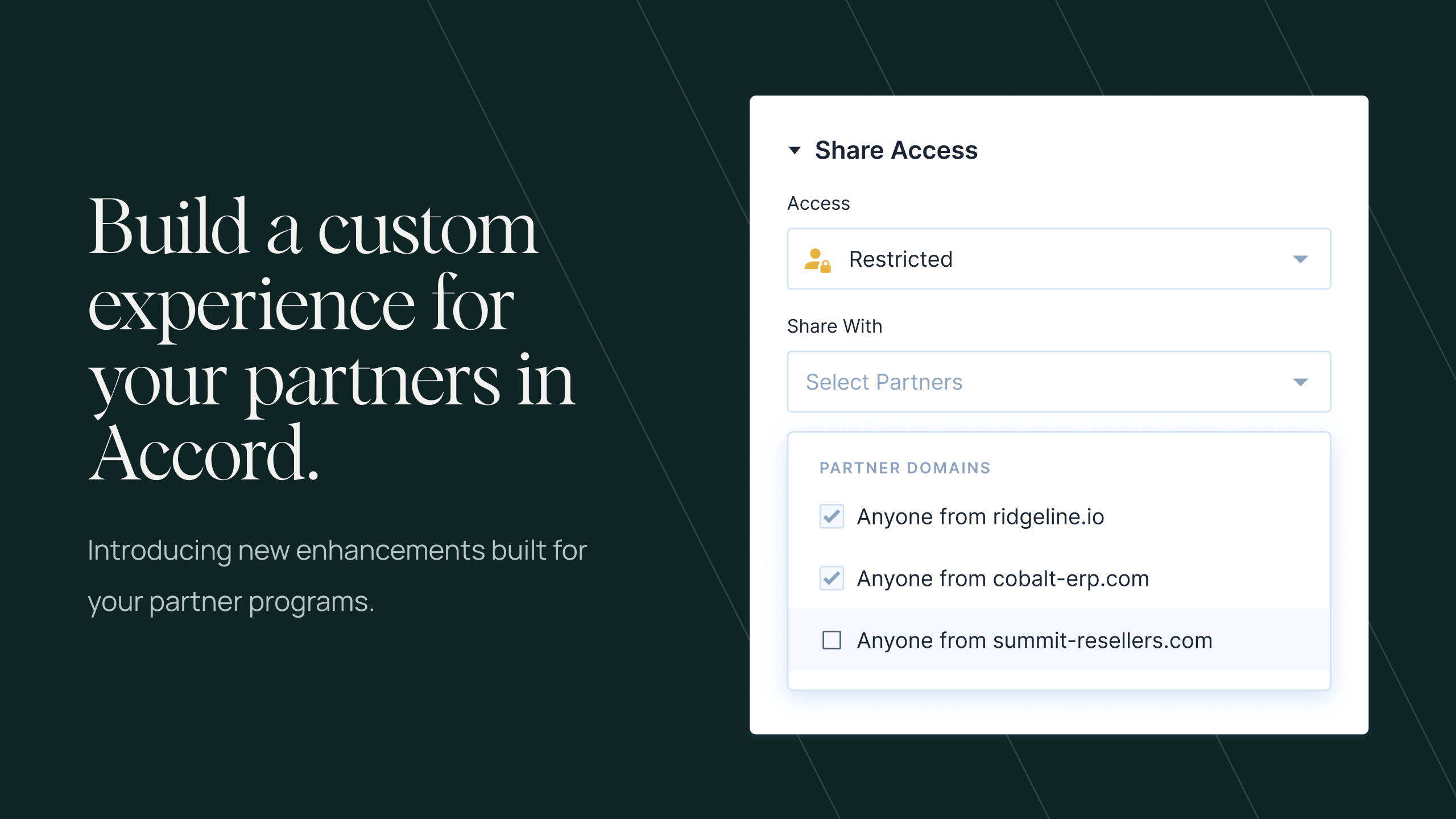
Accord's sales content management replaces standalone content libraries. Teams organize content with folders, tags and curated hubs, then Accord Intelligence surfaces the right case study or security document at the moment it matters, inside the deal playbook, the buyer workspace and Slack, based on what's happening in the deal.
Here are the pros and cons associated with Accord's Sales CMS:
Pros:
Cons:
Best for: B2B teams with complex deals that want content delivered inside their deal playbooks.
Read answers to common questions about Accord, from pricing to integrations.
Seismic is a leading sales enablement platform that merged with Highspot in August 2026 and now serves about 2,500 customers and 3.5 million users. It enables organizations to synchronize marketing and sales efforts.
Here are the pros and cons associated with Seismic's CMS:
Pros:
Cons:
Best for: large enablement teams that need broad integrations across their tech stack.
Highspot is a modern sales enablement platform that helps companies train their sales teams, manage content, engage with customers, and measure the effectiveness of their efforts. Highspot merged with Seismic in August 2026 and is now sold as Highspot by Seismic.
Here are the pros and cons associated with Highspot's CMS:
Pros:
Cons:
Best for: teams that want AI-powered content search and simple content governance.
Founded in 2011, Showpad is an all-in-one, AI-powered solution designed to bring marketing and revenue teams together to empower sellers with the content and training needed to engage buyers. In October 2025, Showpad combined with Bigtincan under the Showpad brand, and it now serves more than 2,000 organizations.
Here are the pros and cons associated with Showpad's CMS:
Pros:
Cons:
Best for: field and mobile sales teams that need content on the go.
The right sales content management system can enhance operational efficiency, streamline content accessibility, and improve sales enablement, but more importantly, it can drive measurable revenue impact through better execution.
Choosing a flexible and feature-rich Sales CMS can help your organization maintain a competitive advantage and growth. But before hastily making a decision, take the time to weigh your options and do your research.
Carefully assess each system's features against your organization's unique needs, particularly how content is delivered to reps, how updates propagate across active deals, and how the platform ties content usage to revenue outcomes. Select a solution that not only fits your current needs but also evolves with your business strategy and sales methodology.
The best Sales CMS platforms don't just store content. They embed it directly into your deal execution workflow, ensure reps always use current materials, and prove ROI through real revenue attribution. That's how you transform content management from a cost center into a measurable revenue driver.
See how Accord's sales content management works, or compare Accord with Highspot, Seismic and Showpad.
A sales CMS focuses on storing, organizing and delivering sales content. Sales enablement platforms usually add training, coaching and analytics on top. Many tools, like Seismic and Showpad, do both.
Most do. CRM integration lets reps open content from the deal and sends usage data back to the CRM. Check how deep each vendor's integration goes before you buy. Accord, for example, updates your CRM automatically and surfaces content inside the deal workspace and in Slack.
Track which assets reps use and buyers engage with, then compare that usage with win rates, deal size and sales cycle length. A sales CMS with usage analytics makes this much easier.
Yes. Seismic completed its merger with Highspot on August 18, 2026. The combined company operates under the Seismic name, and Highspot's product is now sold as Highspot by Seismic.
Seismic and Highspot are content libraries that reps search when they need something. Accord is an agentic revenue execution platform: it surfaces the right case study or security document inside the buyer workspace and in Slack, based on what's happening in the deal, so reps don't have to go looking.