Learn Vanessa Brangwyn's 3 key tips for execution excellence: embracing customer-centricity across the C-suite, leveraging RACI frameworks and clear Rules of Engagement (ROEs), and running cross-functional deal accelerator workshops to unstick large opportunities.
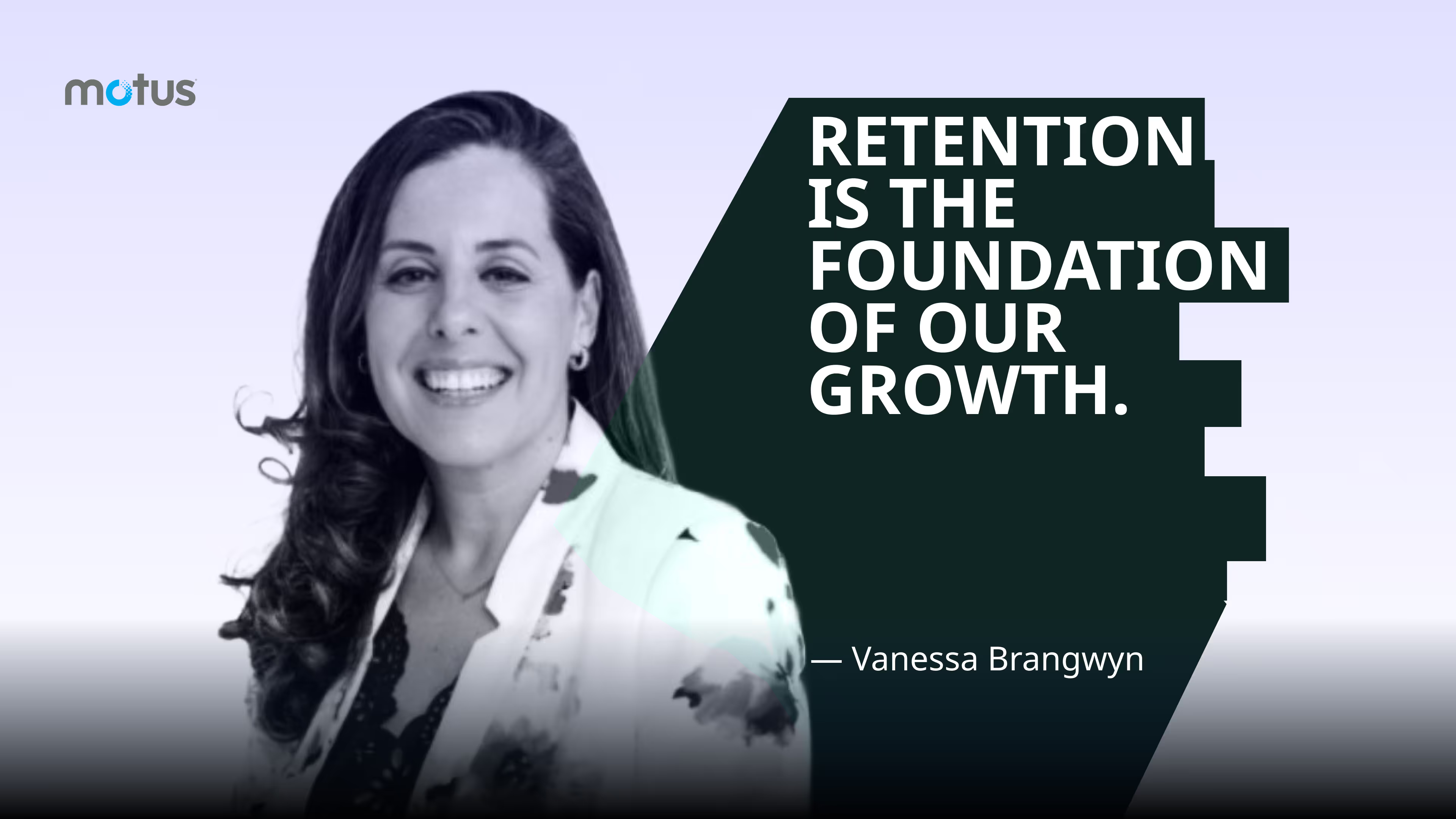
Our guest for is Vanessa Brangwyn, VP Sales, Motus. With more than a decade of revenue experience, Vanessa has held leadership roles at Pavilion and Achievers before joining Motus in 2024.
In this episode, Ross and Vanessa discuss Vanessa’s 3 tips to drive execution excellence: being customer-centric in everything you do, leveraging RACIs and clear ROEs, and running deal accelerator workshops.
Listen to the episode here, and get the key takeaways from our conversation below.
According to Vanessa, being customer-centric isn’t just about having a CS team. “It starts at the top of the entire C-suite,” she says. “At Modus, our CEO proactively reaches out and asks to be part of customer meetings, for both prospective and existing customers. He builds relationships with them. He knows what problems we’re solving and how we’re solving them. And that trickles through our whole organization.”
This top-down approach places customers at the center of your organization’s growth, building stronger relationships, more relevant solutions, and a product roadmap that aligns with what customers actually need. By understanding customer pain points and feedback, teams can innovate more effectively, reduce churn, and build lasting loyalty.
“Retention is the foundation of our growth, and customer retention starts during the sales cycle,” Vanessa continues. “When you put the customer at the center of what you do, you’re able to deliver around those expectations and ambitions you have for your organization.”
Being customer-centric also means selling the right solution to the right customer at the right time. That requires honesty and alignment during the sales process. “Sell the product as it works today, and meet the customer’s current expectations,” Vanessa explains. “If there are future features coming — which, of course, there always are in an innovative, high-growth company — absolutely talk about them. But be clear in setting expectations. And ultimately, if it’s not the right fit long-term, it’s okay to disqualify opportunities.”
Another key element of driving execution excellence is leveraging rules of engagement (ROEs) and the Responsible, Accountable, Consulted, and Informed (RACI) framework. “At Motus, our new logo team and account management teams work closely together to bring in more market share,” says Vanessa. “Motus sells into any organization and any vertical that has employees who drive personal vehicles, and that spans a wide range of industries. There’s also a significant amount of convergence happening, with a lot of M&A activity. So we might have a longtime Motus customer who gets acquired by a prospect. How are we going to work together to expand that opportunity? Or two organizations that are already Motus customers might merge under a new parent company. Those scenarios create countless opportunities for collaboration, and that’s really why we created the rules of engagement.”
At Motus, ROEs are designed to provide structure and solve for 85 to 90 percent of situations, creating consistency across the board. The goal is to present a united front to the customer, rather than giving the impression of working with multiple disjointed teams.
“That's exactly where not only the ROEs come into play, but also the RACI framework,” Vanessa explains. “RACI helps clarify decision making by outlining who’s Responsible, Accountable, Consulted, and Informed. This ensures everyone knows their role, whether you’re working across multiple sales teams, regional teams, vertical-based teams, or collaborating with account management and customer success.”
When implementing your own ROEs and RACIs, Vanessa recommends starting with the customer. Ask yourself:
“We do a lot of listening to our sellers and reps to understand what’s worked well in the past, and what hasn’t,” Vanessa adds. “Our current rules of engagement were a collaborative effort, shaped by employee feedback, rep insights, and co-creation with sales leaders, sales management, our VP of go-to-market strategy and enablement, and RevOps because these frameworks have to be operationalized to work effectively. What I don’t recommend is creating them in isolation. You can’t just sit in a room, build the process yourself, and then announce, ‘Here’s how it’s going to work.’ Collaboration is key.”
Vanessa’s final key to execution excellence is holding deal accelerator workshops, internal sessions designed to help teams problem-solve when a deal feels stuck.
“It could be stuck for a number of reasons,” Vanessa explains. “Maybe the customer’s pain points have changed, priorities have shifted, the decision maker has changed, or we’re simply not connected to the right decision maker. These workshops are mostly focused on our largest opportunities, but the format applies to deals of any size. We bring together a cross-functional team — with representation from product, marketing, legal, finance, customer success and implementation, and even fellow sales reps and leaders — to really go deep on a deal. We review the high-level headlines, the key personas, the pain points, the value proposition, and what we’ve tried so far. Then, we move into a brainstorming phase where there’s no such thing as a bad idea. Even if you’re the rep and you’ve already tried every suggestion, the act of sharing and collaborating often sparks new creativity.”
This approach not only drives fresh perspectives but also reinforces cross-functional collaboration. “It helps the entire business see themselves as part of the sales function,” Vanessa says. “Just like customer success isn’t a siloed function, sales isn’t either. It takes the proverbial village to win, especially with our largest, most strategic opportunities. Even our CEO attends these workshops when he can, which really underscores the collective hunger to not just win deals for the sake of winning, but to do right by the customer.”
Enablement also plays a key role. A representative from the enablement team sits in on every workshop to identify patterns and areas for improvement. “It helps us pinpoint themes,” Vanessa notes. “For example, if 75% of our deals are stalling at the same stage, we can identify that trend and create resources or training to help the entire team navigate it more effectively.”
While these workshops are often focused on large, high-stakes deals, the format has been successfully adapted for smaller teams as well. Sales leaders frequently run their own sessions to enable collaboration and peer learning. “There’s real power in seeing a fellow rep share their experience,” Vanessa says. “Hearing how someone navigated a similar situation is great for enablement, great for camaraderie, and most importantly — great for winning.”
Vanessa started her career in the tech space, and spent a lot of time in the CS world before working her way up the revenue ladder. She credits her success to a combination of people taking a chance on her and her ability to stay resilient in a rapidly evolving tech landscape, a journey that eventually led her to serve as CCO and, later, CRO, overseeing everything across pre- and post-sales.
To learn more about Vanessa or connect with her directly, follow her on LinkedIn.