In this episode, Ross and Scott discuss the future of AI in sales, from redefining trust in an automated world to aligning GTM motions with modern behavior.
Welcome back to the Revenue Execution Podcast!
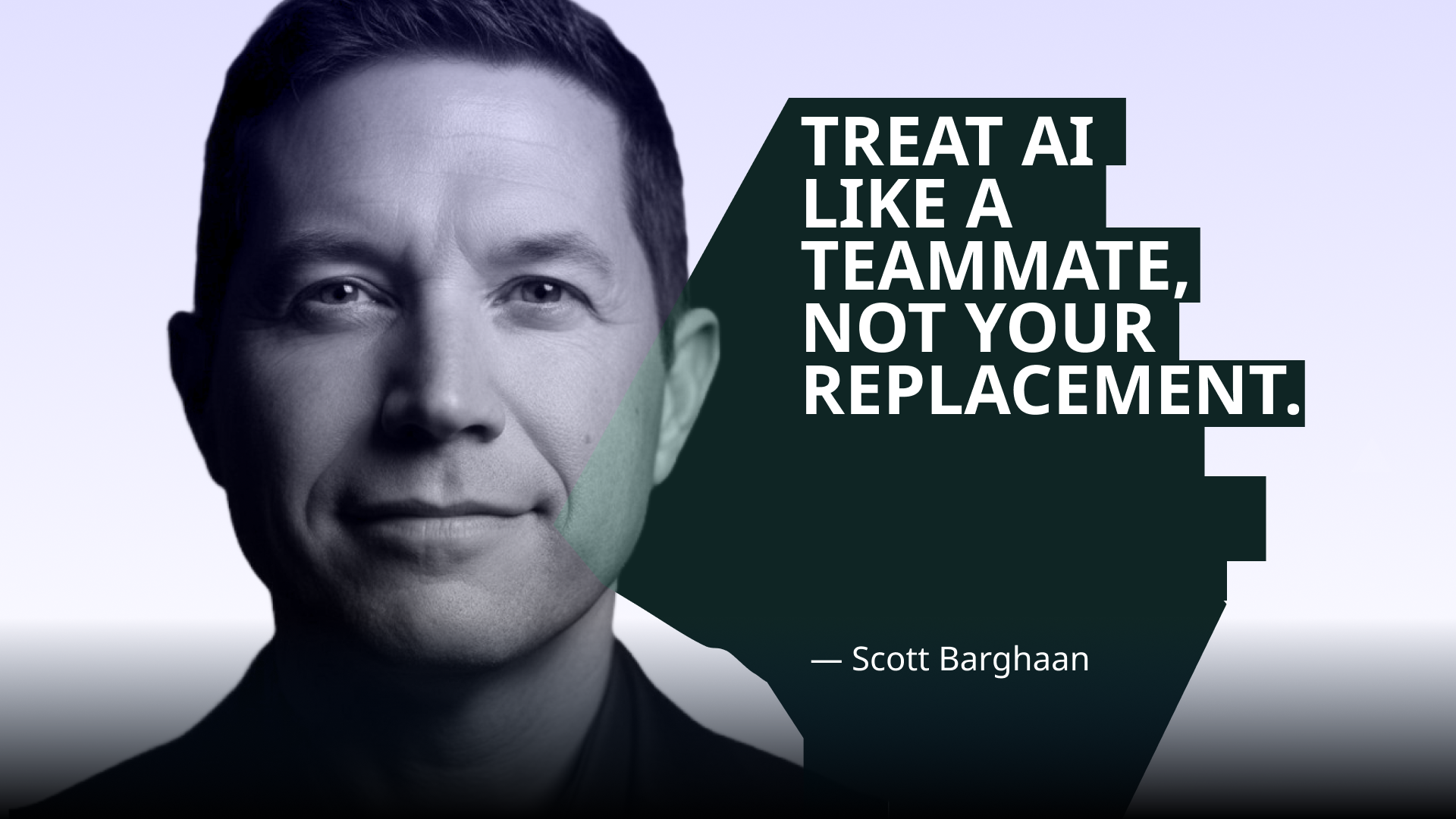
Our guest for this episode is Scott Barghaan, a seasoned sales leader who serves as an advisor, professor, and investor to a range of organizations. Prior to joining the Kellogg School of Management, Scott held leadership roles as an SVP at Salesforce and GM at Dell. He brings more than two decades of experience to the conversation.
In this episode, Ross and Scott discuss the future of AI in sales, from redefining trust in an automated world to aligning GTM motions with modern behavior. They wrap up the conversation with predictions of what AI means for 2026.
Listen to the episode here, and get the key takeaways from our conversation below.
There’s no question AI is reshaping sales, but not always in the ways people expect. While much of the conversation focuses on whether AI will magically fix pipeline gaps, productivity issues, or long sales cycles, the reality is more nuanced.
“For every IC thinking, ‘How can I use my team differently and how do I delegate responsibility to others and how can I be in all the places I need to be today?’ That’s the perfect area where I’m seeing the maturation of AI,” says Scott.
Whether it’s preparing for a conversation with a role a seller has never engaged with before or trying to understand how similar buyers have used a product in the past, AI now makes it possible to quickly surface relevant context and meaningful patterns. Previously, pulling that information together either took an enormous amount of time or simply wasn’t feasible at scale because the data was too raw or fragmented. Now, sellers can access those insights far more easily, and act on them.
Scott also sees AI maturing in how sellers execute meetings themselves, especially as buyer expectations continue to rise. Today’s buyers are coming into conversations more informed and more intentional. They’re not there for exploratory “first dates” anymore — they’re there for a reason. That means sellers have to bring everything they’ve learned into the room and use it to create value in that moment.
“The goal isn’t to take more meetings just because you can,” Scott explains. “The point is to use every meeting to find a better match between you and that customer.”
But AI doesn’t replace the person. Instead, it helps reps show up more prepared so they can work faster and more efficiently.
AI isn’t a shortcut or a cure-all. It amplifies the impact of sellers who are already doing the work and have the fundamentals in place.
“It has relevance for everybody,” explains Scott. “But my hot take is that it still comes down to hiring the right people into these roles.”
AI can’t fix poor selling or replace core skills (like collaboration, judgment, coachability). Sellers still need the ability and willingness to learn, adapt, and delegate. Without those foundational skills, AI won’t meaningfully change outcomes. It simply accelerates activity without improving direction, helping sellers do more of the wrong things, faster.
Where AI shows the most impact is with strong B reps. These are the sellers who have the raw skills but lack depth in a specific industry, buyer role, or problem space. When treated as a teammate rather than an outsource, AI helps them prepare faster, uncover patterns in messy data, and show up to conversations with sharper context.
“The person that can be coached,” Scott explains, “AI is like this multiplier of that coaching ability.”
Digital transformation is often messy, especially when leaders are under pressure to connect an expanding tech stack to real business results.
For GTM leaders stuck in that tension, the question isn’t whether to invest in AI, but how to move from chaos to alignment. How do teams stop mistaking activity for progress? And how do they shift from busy work to decisions that actually move revenue, customer outcomes, and execution forward?
When it comes to integrating AI into your organization, it’s not as simple as updating your tech stack and expecting everything to work perfectly. Just as you’d train a new hire, AI also needs to be trained, guided, and integrated into how work gets done.
“Mike Murchison, CEO of Ada, said recently that you need to treat AI like a teammate, and he’s exactly right,” Ross explains. “Imagine hiring a CRO or CMO and expecting them to drive results on day one. How many people do they need to talk to? How many calls do they need to listen to? That learning curve exists for AI too, but people haven’t been treating it that way.”
Scott agrees, and points out that this disconnect often shows up when top-down pressure collides with bottom-up reality.
“The fundamentals are still the fundamentals,” Scott says. “You’ve got board-level pressure seeing automation headlines like margin recapture, scale, and productivity and that pressure gets pushed onto teams. At the same time, from the bottom up, you’ve got people being asked to do 200 to 300% more work without clarity on what actually matters. And no one is really stitching those two things together.”
That gap, Scott argues, is why so many AI initiatives stall or create noise instead of leverage. Leaders chase features, agents, and automation strategies without first answering more basic questions such as:
“One of my hot takes for 2026 is that data quality and governance are going to matter more than new features,” says Scott. “Yes, people will talk about managing agents or building agentic products, but at scale, the real issue is deciding why you’d use one capability over another, or whether you even need an LLM at all. In some cases, a simple automation is the better choice.”
At the heart of transformation is clarity. Clarity around intent, inputs, and outcomes. Without it, even the most advanced AI tools risk amplifying confusion instead of progress.
“It comes down to brass tacks,” Scott adds. “What exactly do we want from these tools? How do we measure that they’re doing more good than harm? And how do we recognize that the quality and consistency of our data matters more than what clever things we can do with bad inputs?”
Selling is hard, but buying is even harder. Buyers are navigating more stakeholders, more risk, and more internal scrutiny than ever before, and they’re doing much of that work before a seller ever enters the picture.
“One of the most fascinating parts of my role doing sales transformation at Salesforce was that I was the buyer,” Scott explains. “And that’s how I learned that the meeting where you win or lose a deal is one you’re unlikely to be in.”
Buyers, he notes, are often doing five to ten times more activity than sellers realize. In enterprise environments, Scott recalls using walking decks to help buyers bring new stakeholders up to speed and reduce risk.
As a result, buyers aren’t coming to sellers for basic education. They’re coming for validation, perspective, and risk reduction.
“They’ve watched your demo. They’ve read the reviews. They’ve probably talked to people who use your product,” Scott says. “They’re not asking you to educate them. They're asking you to help them de-risk the buying process.”
That changes how sellers need to show up. Old habits like running generic discovery and pushing demos often miss the mark. The most effective sellers arrive with insight into how similar buyers have navigated the decision, what questions tend to surface later, and where deals commonly stall or fail.
“What buyers really want,” Scott adds, “is someone who’s been there and done that — or at least can bring the perspective of people who have.”
In practice, that means the seller’s job increasingly blends sales, solution engineering, business value, and customer success. Conversations skew earlier toward post-sale realities such as implementation, adoption, internal enablement, and long-term outcomes. Buyers aren’t just asking what does this do? They’re asking how do I avoid screwing this up?
As AI continues to mature, teams may get smaller, but the role of the seller will expand to managing more complex accounts, earning greater trust, and capturing more of the value they create.
Looking ahead, Scott sees a widening gap between transactional selling and becoming a trusted advisor to buyers.
“I think there’s a greater opportunity for sellers who are willing to be deeper customer partners,” he says. “Every piece of research you could point to will show you that that’s what buyers want.”
Instead, Scott believes the real opportunity lies in redesigning the work itself:
“You’re not doing this just to save sellers time,” Scott explains. “You’re doing it to reallocate their time.”
In 2026, Scott expects leaders to ask more of sellers, but only after removing friction from their day-to-day. If AI handles documentation and administrative work, sellers should spend that reclaimed time preparing more deeply for customer conversations, understanding buyer context, and anticipating risk before it surfaces.
At the same time, Scott cautions against assuming productivity gains are infinite. Sales work is not purely mechanical. It requires emotional energy, judgment, and human connection. A day filled entirely with high-intensity work is not sustainable.
“We’re not robots,” he says. “There has to be a rhythm to the work.”
Ultimately, Scott believes the future of sales still comes back to trust. AI can help sellers make stronger arguments, surface better data, and show their math, especially in high-stakes buying decisions. But trust is not eliminated by automation. It is reshaped.
“In low-stakes situations, relationships can carry weight,” Scott says. “In high-stakes decisions, buyers need proof. They need confidence that this will work.”
Scott is a sales and GTM leader who’s spent his career working alongside teams in retail, travel, hospitality, manufacturing, and financial services. He’s passionate about helping organizations use technology, data, and smarter processes to create better experiences.
A multi-year Dreamforce speaker and Double-Star Trailhead Ranger, Scott regularly shares insights on the future of sales, GTM strategy, and AI. To learn more or connect with him directly, follow Scott on LinkedIn.